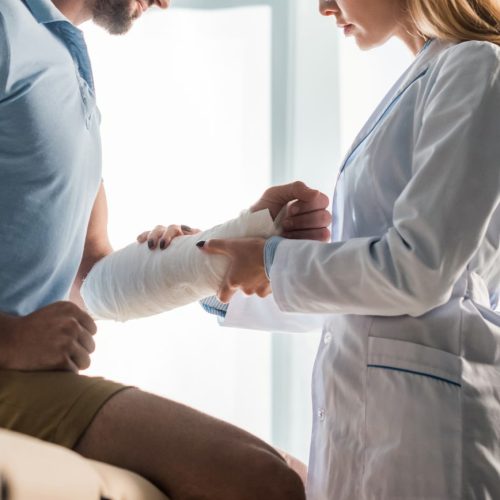
A fracture is a break in a bone. Fractures range from a hairline crack to a bone broken in several pieces, and from a closed fracture, where the skin is intact, to an open (compound) fracture, where the bone has broken through the skin.
Diagnosis
X-rays confirm most fractures. A CT scan gives more detail when a fracture involves a joint or is complex, and helps plan surgery.
Treatment without surgery
Many fractures heal well in a cast, splint, brace or sling, provided the bone ends are in an acceptable position. Sometimes the bone is first manipulated back into position under anaesthetic (a closed reduction). X-rays during healing make sure the position is held.
When surgery is needed
Surgery is usually recommended when a fracture is displaced and can’t be held in a good position without it, when it involves a joint surface, when there are multiple fractures, or when the bone has broken through the skin. The aim is to restore alignment and hold the bone still while it heals.
Plates and screws fix the bone fragments directly (open reduction and internal fixation)
Intramedullary nails are rods placed down the hollow centre of long bones such as the thigh and shin
Wires are used mainly for small bones and in children
External fixators are frames outside the limb, attached to the bone by pins, often used as a temporary measure after serious injuries
Open fractures are treated as emergencies, with antibiotics and surgery to clean the wound, because of the risk of infection.
Healing
Most fractures take about six to twelve weeks to unite, and longer to regain full strength. Healing can be slower in older people, in smokers, in people with diabetes, and in certain bones. Occasionally a fracture doesn’t heal (non-union) or heals in the wrong position (malunion), and needs further treatment. Physiotherapy restores movement and strength once the bone allows.
BMR Surgeons who Treat This
Dr K. Naik, Dr D.D. Beekarun, Dr S. Khan, Dr A.D. Bhatta, Dr P. Reddy (foot and ankle), Dr L. Rajah (upper limb), Dr S. Ragunandan.