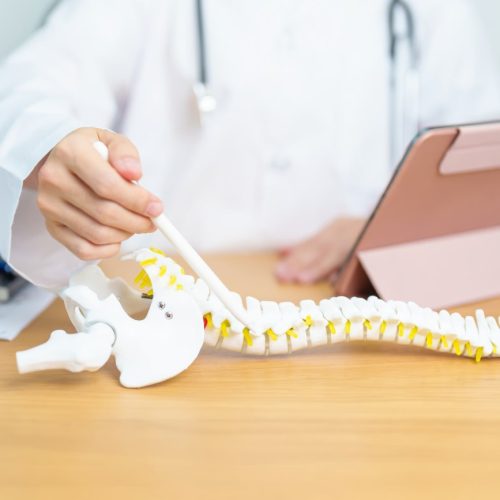
The spine is a column of vertebrae separated by discs, which act as shock absorbers. With age, the discs lose water and height, and the small joints at the back of the spine can develop arthritis. These changes are common, and many people with them on a scan have little or no pain. They cause problems when they lead to persistent pain or press on nerves.
Slipped (herniated) disc
A “slipped” disc hasn’t moved out of place. The soft centre of the disc has pushed through a weakness in its outer layer and presses on a nearby nerve. In the lower back, this causes sciatica: pain radiating down the leg, often with numbness or pins and needles. In the neck, it causes pain, numbness or weakness in the arm.
Spinal stenosis
Spinal stenosis is a narrowing of the canal that carries the nerves, from thickened ligaments, arthritic joints and bulging discs. In the lower back, it typically causes pain, heaviness or numbness in the legs when walking or standing, which eases on sitting or bending forward.
Diagnosis
Diagnosis combines your history, an examination of the nerves (strength, sensation and reflexes) and an MRI scan. X-rays can show alignment and instability.
Treatment
Most disc-related sciatica improves within weeks to a few months without surgery. Non-surgical treatment includes pain relief, staying as active as possible, physiotherapy and, in some cases, a spinal injection.
Surgery may be recommended when leg or arm pain is severe and not improving, when there is increasing weakness, or when stenosis significantly limits how far you can walk. The main aim is to relieve pressure on the nerve (decompression), by removing the disc fragment or the tissue narrowing the canal. Where the spine is unstable, it may also need to be stabilised with a spinal fusion.