
Hip replacement (total hip arthroplasty) replaces a damaged hip joint with an artificial one. The worn ball at the top of the thigh bone is replaced with a metal or ceramic ball on a stem, and the socket in the pelvis is lined with a cup of metal, plastic or ceramic.
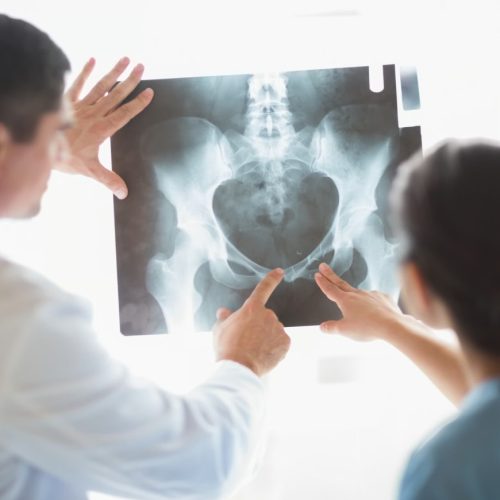
Most hip replacements are done for osteoarthritis, where the cartilage that cushions the joint has worn away. Other reasons include rheumatoid arthritis, avascular necrosis (loss of blood supply to the ball of the hip), some hip fractures, and arthritis after an earlier injury or a childhood hip condition.
Typical symptoms are pain in the groin, thigh or buttock, stiffness, a limp, difficulty with shoes and socks, and pain at night. Surgery is usually considered when these significantly limit daily life and non-surgical treatment (pain relief, physiotherapy, weight management, a walking aid or injections) is no longer enough.
The operation usually takes one to two hours under a spinal or general anaesthetic. Most people stand and begin walking with help on the day of surgery or the next day, and stay in hospital for a few days.
Most people have a good result, but risks include infection, blood clots, dislocation of the new joint, a difference in leg length, fracture around the implant, and nerve or blood vessel injury. Over many years, the implant can wear or loosen. Your surgeon will explain how these risks apply to you.
If a hip replacement wears out, loosens, becomes infected or dislocates repeatedly, a second operation (revision) may be needed to replace some or all of the parts. Revision is more complex than a first-time replacement, and is usually done by surgeons with specific experience in it.
Dr S.A. Moodley, Dr S. Sathyapal, Dr A.D. Bhatta, Dr S. Khan, Dr D.D. Beekarun. Revision surgery: Dr A.D. Bhatta, Dr S. Khan.